


Designing within the limits of rotomoulding
What limitations exist in rotomoulding in terms of design complexity, and how can designers overcome these constraints to maximise functionality and aesthetics?
Rotational moulding offers extensive design freedom, but like any manufacturing method, it has constraints that influence geometry, tolerances and fine details. Understanding these limitations allows designers to optimise shapes, improve manufacturability and achieve both functional and aesthetic goals. By combining thoughtful geometry with the right engineering solutions, rotomoulded components can remain visually appealing, structurally reliable and cost-efficient.


Key design limitations in rotomoulding
Rotomoulding relies on gravity-driven material flow, which means certain geometric features require careful consideration to achieve consistent results. Very thin walls, abrupt transitions or sharp edges may lead to uneven thickness, affecting strength and stability. Fine details such as small text, micro-textures or tiny radii can be difficult to reproduce, as the polymer powder must melt and adhere to the mould surface uniformly.
Another important factor is tolerance control. Because the process uses slow heating and natural cooling, rotomoulded parts typically have looser tolerances compared to injection-moulded components. Designers should plan for 0.5–1% dimensional variance, depending on the size and geometry of the part, ensuring predictable performance and smooth assembly.
Strategies to overcome design constraints
A well-designed rotomoulded part can achieve high structural integrity and excellent aesthetics when engineers account for process-driven limitations early in development. The following techniques help maximise functionality and manufacturability:
- Use ribs, gussets and reinforced transitions
Structural features can increase rigidity while maintaining low weight and avoiding thick, material-heavy walls.
- Incorporate smooth radii and gradual tapers
Rounded edges ensure consistent material flow and prevent weak points caused by sharp transitions.
- Combine aesthetic design with mould-based detail
Textures, patterns, logos, and colour are applied directly in the mould surface, eliminating secondary finishing steps.
- Apply double-wall or hollow-section design
These geometries enhance strength, insulation or buoyancy without adding unnecessary mass.
- Consider post-mould finishing when required
CNC trimming or robotic cutting helps achieve precise openings or tighter tolerances when the application requires higher accuracy.
By integrating these solutions, designers maintain full control over structural behaviour, appearance, and weight – ensuring that the final product performs reliably while meeting demanding visual standards.

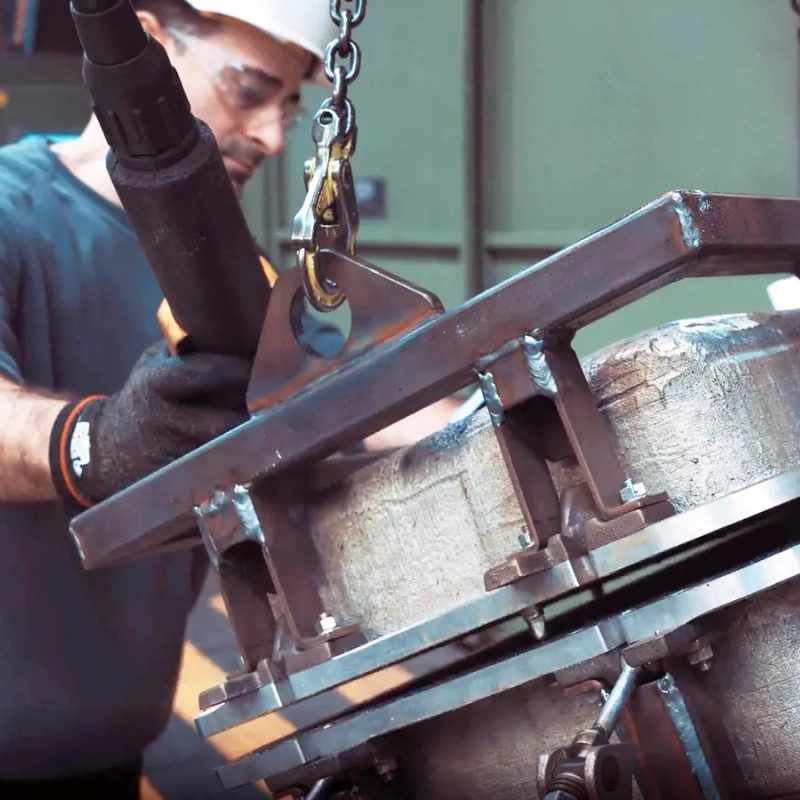
Enhancing functionality and aesthetics through smart geometry
Smart design choices can transform limitations into opportunities. For example, instead of relying on extremely thin surfaces, designers can create curved profiles or domed sections that naturally increase stiffness. Strategic placement of ribs or internal cavities allows large components to remain lightweight while resisting deformation.
Aesthetic value can also be enhanced by leveraging the mould itself. Rotovia’s custom moulding capabilities allow designers to embed branding, smooth or textured finishes, and bespoke colour selections into the component surface. This eliminates post-processing, reduces waste and ensures that the part’s appearance remains consistent throughout its lifecycle, even in demanding outdoor or industrial environments.
Contact our team to explore how Rotovia’s custom moulding expertise can transform your complex design into a functional, manufacturable and visually compelling rotomoulded product.
FAQ
Why are very fine details difficult to achieve in rotomoulding?
Rotomoulding uses powdered polymer that must melt and adhere to the mould surface while rotating. Extremely small features, such as sharp text, micro-patterns or very narrow recesses, may not receive enough material coverage to form cleanly. Smooth transitions, larger radii and well-defined embossing or debossing improve detail clarity and ensure consistent surface quality.
How can designers manage tolerance limitations?
Because the process relies on low pressure and slow cooling, rotomoulding produces broader tolerances compared to injection moulding. Designers should plan for 0.5–1% dimensional variation, depending on part size. To achieve tighter tolerances in specific areas, openings or edges can be post-trimmed using robotic cutting or CNC finishing, ensuring stable fit and alignment during assembly.
Can complex shapes be produced without compromising strength?
Yes, when geometry is optimised for material flow and stress distribution. Features such as rounded edges, domed surfaces, ribs and hollow cores reinforce the structure while keeping the component lightweight. Rotomoulding’s low internal stress also enhances fatigue resistance, allowing complex shapes to maintain strength even under load or in outdoor conditions.
How can designers avoid uneven wall thickness?
Uniform material flow can be achieved by avoiding sharp transitions, extremely thin sections or abrupt changes in geometry. Gradual tapers and smooth radii help the polymer distribute evenly over the mould surface. For added stability, reinforcement features can be integrated to support thicker sections without overusing material.
What techniques improve visual appeal in rotomoulded products?
Aesthetics can be enhanced directly in the mould through textured surfaces, matte or glossy finishes, embossed branding, integrated colour or multi-panel patterns. These techniques eliminate the need for post-painting or coating while ensuring long-lasting visual quality. Rotovia’s engineering teams support customers in selecting the right combination of textures and geometry to achieve both functional and aesthetic goals.
your idea
to life. Start now!
